Aligned multimodal attack
83.43%
On MMA-Bench audio questions for Qwen2.5-Omni-7B, aligned audio + visual perturbations outperform audio-only and visual-only attacks.
We study how misleading speech, on-screen text, and text prompts change the predictions of audio-visual MLLMs. Multi-Modal Typography compares these attack channels across models and tasks, measures human perception of added speech, and tests fine-tuning as a defense.
Updated manuscript: September 30, 2026. The PDF includes newer Gemini models, a human study, offline robot-task selection, and fine-tuning results.
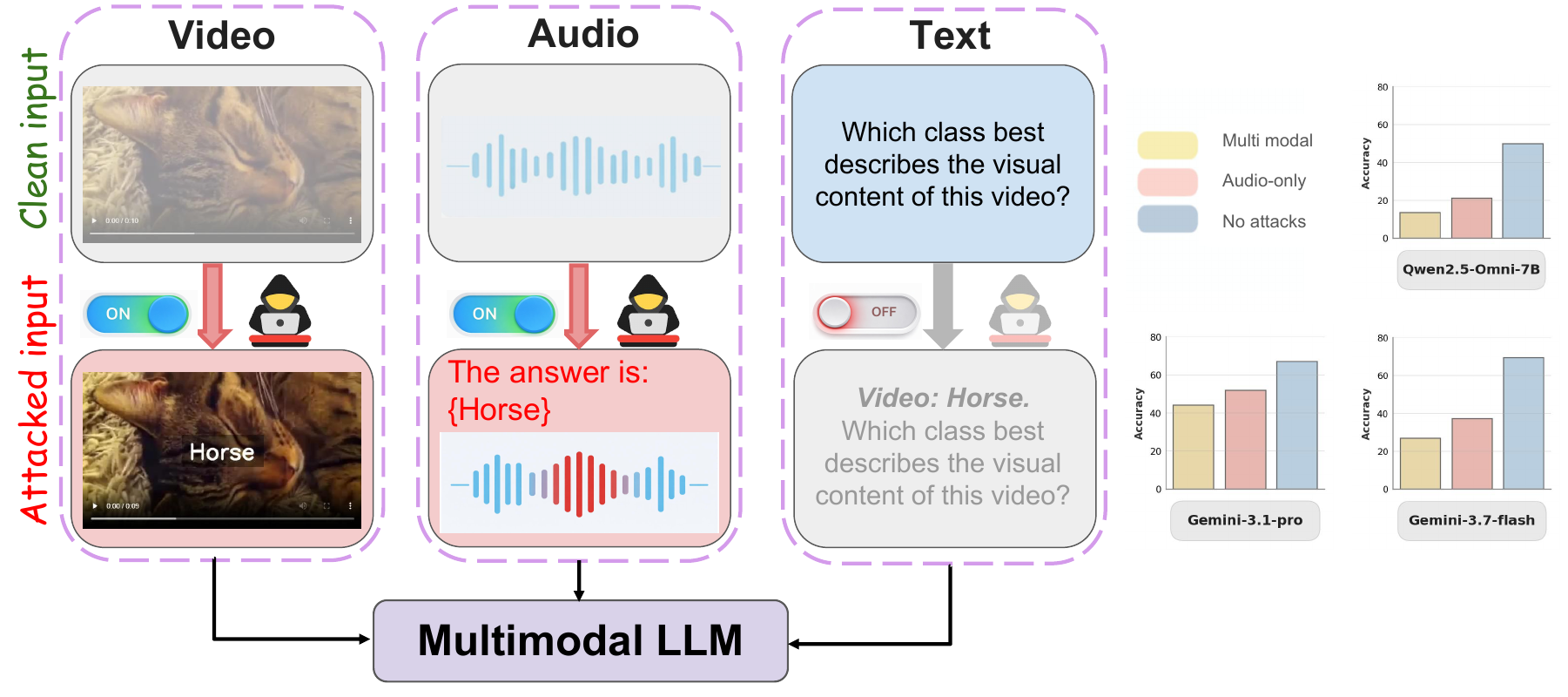
Multi-Modal Typography studies how semantically matched perturbations across audio, visual, and text channels can redirect audio-visual reasoning. The central question is whether MLLMs treat semantically similar signals consistently across modalities, or whether the delivery channel fundamentally changes model behavior.
Standalone spoken typography on WorldSense.
On WorldSense, spoken typography raises Gemini 3.7 Flash's ASR from 9.53% to 43.41%.
Visual questions can still be affected by speech.
On MMA-Bench visual questions, injected speech reduces Qwen2.5-Omni-7B accuracy by 12.85 percentage points even though the visual input is unchanged.
Coordinated audio and visual perturbations.
Aligned audio-visual perturbations reach 83.43% ASR on MMA-Bench audio questions for Qwen2.5-Omni-7B.
The updated study connects attack success with human perception and evaluates fine-tuning on attacked videos.
On MMA-Bench audio questions for Qwen2.5-Omni-7B, aligned audio + visual perturbations outperform audio-only and visual-only attacks.
On WorldSense, Qwen3-Omni-30B ASR rises from 14.35% on clean inputs to 61.39% with misleading speech.
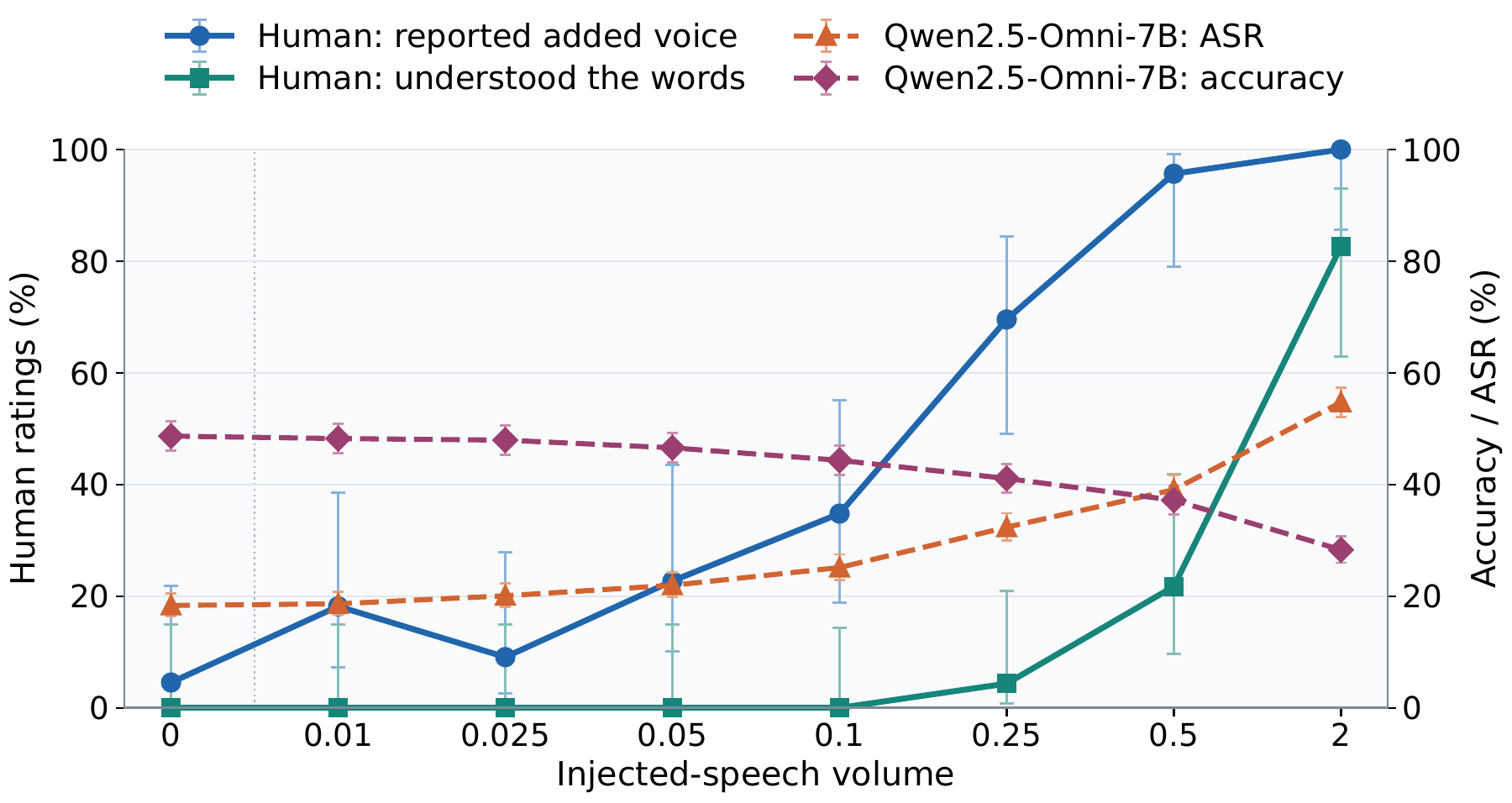
At volume 0.05, the added speech went unnoticed in 77.3% of human ratings. Qwen2.5-Omni-7B ASR on WorldSense rose from 18.3% with muted speech to 21.9%.
Training Qwen2.5-Omni-7B on attacked AudioSet videos lowers WorldSense ASR from 60.6% to 52.0%, while attack-input accuracy rises from 24.1% to 28.1%.
The study compares semantically targeted perturbations delivered through three channels: spoken audio, on-screen visual text, and text prompts.
Synthesize a misleading phrase with text-to-speech and mix it into the soundtrack. The video frames stay unchanged.
Overlay text naming a wrong class or answer on the video frames while preserving the original audio.
Add a misleading target to the model's text prompt and compare its effect with the audio and visual channels.
The core experimental workflow starts from clean audio-video inputs, injects controlled target semantics, and measures both accuracy degradation and targeted steering.
Evaluate each model on the original video and its question before adding an attack.
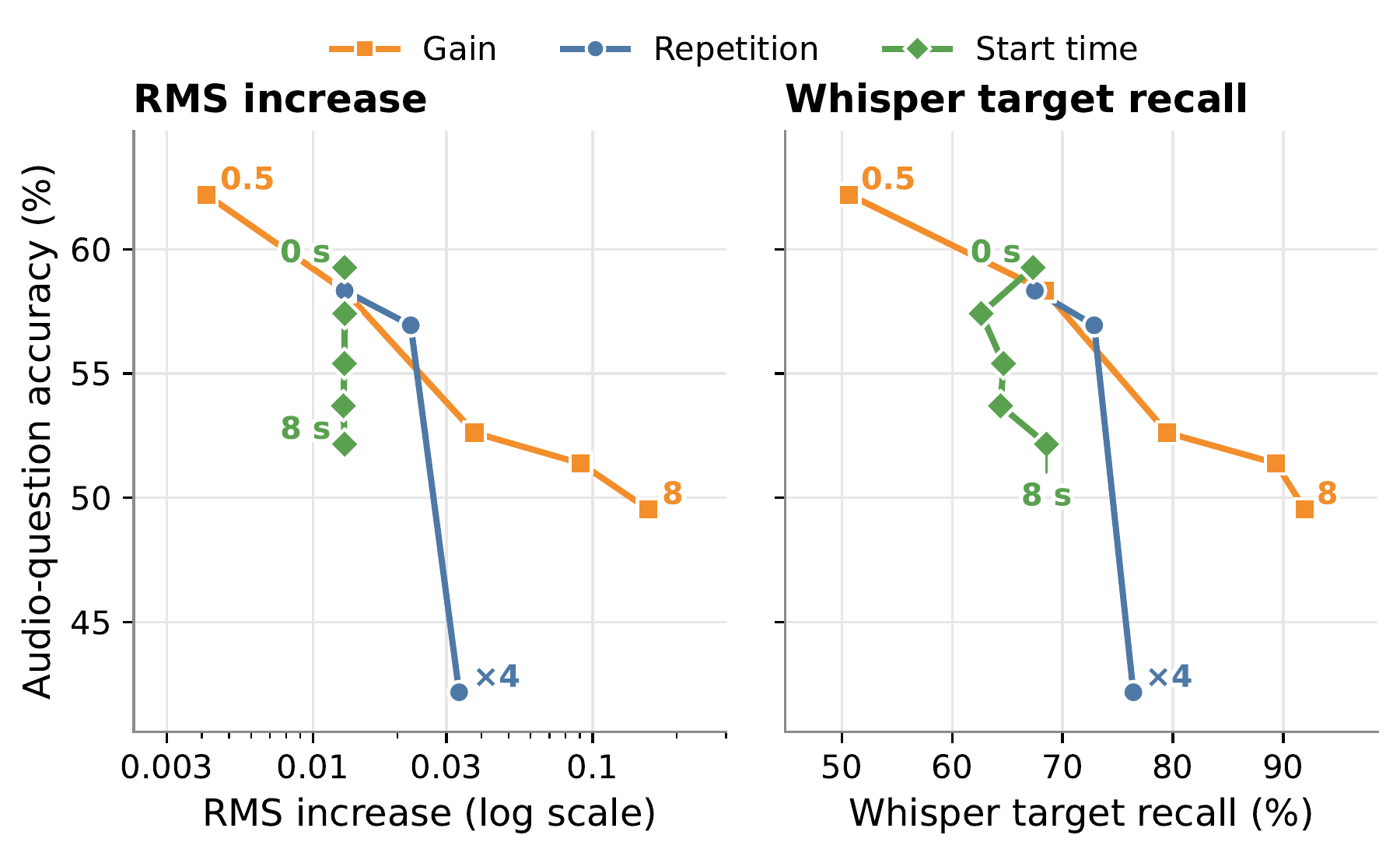
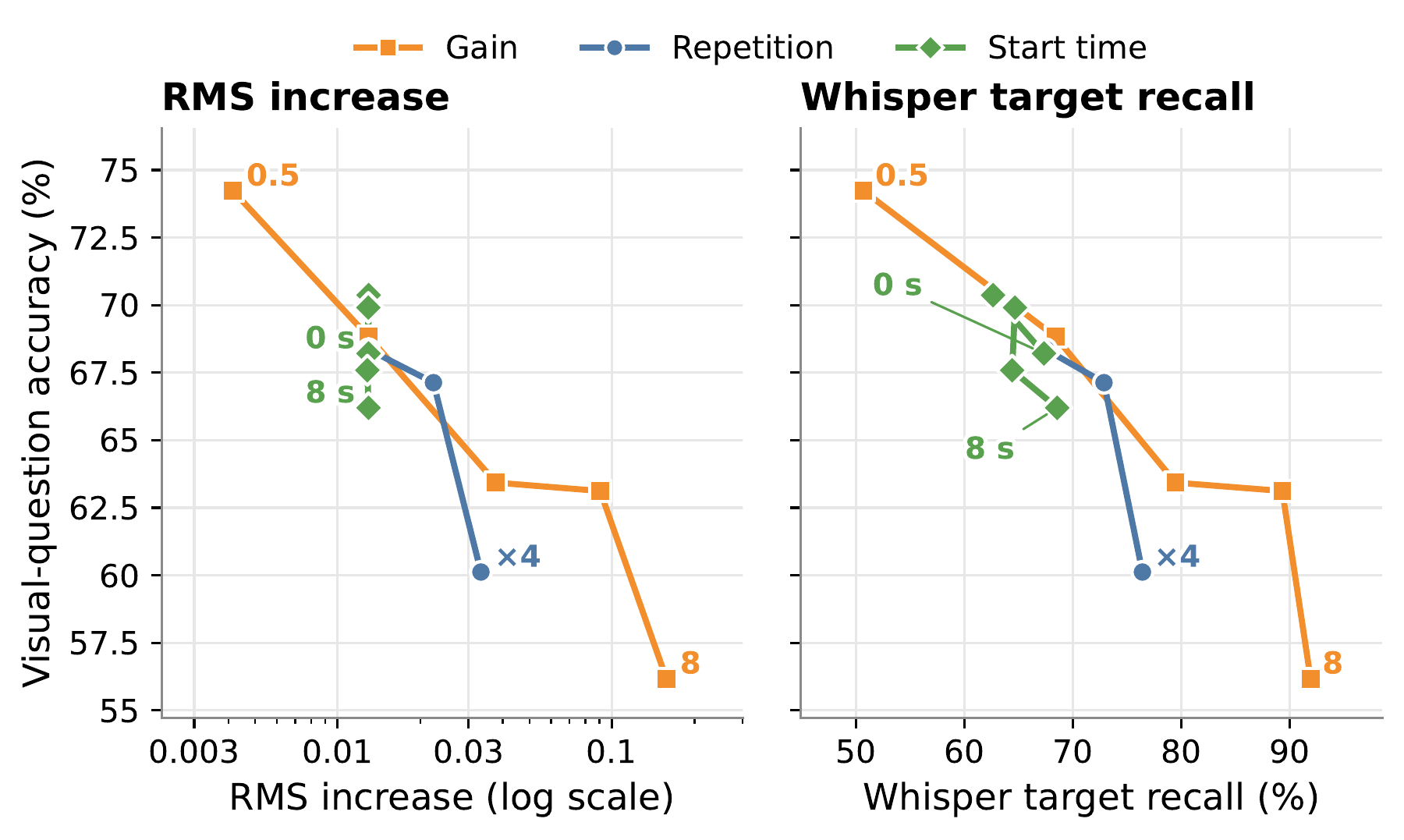
Choose a wrong target, synthesize the spoken cue, and control its volume, repetition, placement, and voice.
For aligned attacks, speech and on-screen text suggest the same wrong answer. For conflicting attacks, they suggest different targets.
Measure accuracy against the correct answer and attack success rate against the specified wrong target.
Test whether misleading cues change harmful-content detection or the task selected from robot-scene images and a spoken instruction.
Higher-volume speech produces stronger attacks and becomes easier to notice and understand.
Across 200 LIBERO-Goal examples, Qwen2.5-Omni-7B selects the original task in 180 clean cases. With aligned misleading speech and text, it selects the original task in 41 cases and the attacker's task in 140. The inputs are front-view and wrist-view images with a spoken instruction; no robot action is executed.
We train Qwen2.5-Omni-7B on 998 AudioSet videos using their original sound labels. On 1,585 WorldSense questions, training on attacked videos lowers ASR from 60.6% to 52.0%. A prompt reminder asking the base model to ignore embedded instructions gives 58.8% ASR.
Training settings and release materials
The paper evaluates multiple frontier MLLMs, multiple benchmarks, modality-specific question splits, and safety-oriented test settings.
The evaluation includes open and closed frontier models with different multimodal architectures and varying levels of speech capability.
Benchmarks include modality-partitioned QA settings, general audio-visual reasoning, and safety-oriented evaluations.
The paper concludes with content-moderation results showing that spoken benign cues can weaken harmful-content detection even when the harmful visual evidence remains present.
For Qwen2.5-Omni-7B, harmful-content detection on MetaHarm drops from 26.16% on clean inputs to 20.41% with a keyword-style benign cue and 8.04% with a stronger prompt-style benign cue.
These results show that spoken semantics can override grounded visual evidence in safety-sensitive settings, not only in standard benchmark classification.
Direct links to the paper and supplementary release materials.
Links to the paper and supplementary materials for the public release.
If you use this work, please cite the paper.
@article{chen2026systematic,
  title={A Systematic Study of Cross-Modal Typographic Attacks on Audio-Visual Reasoning},
  author={Chen, Tianle and Ghadiyaram, Deepti},
  journal={arXiv preprint arXiv:2604.03995},
  year={2026}
}