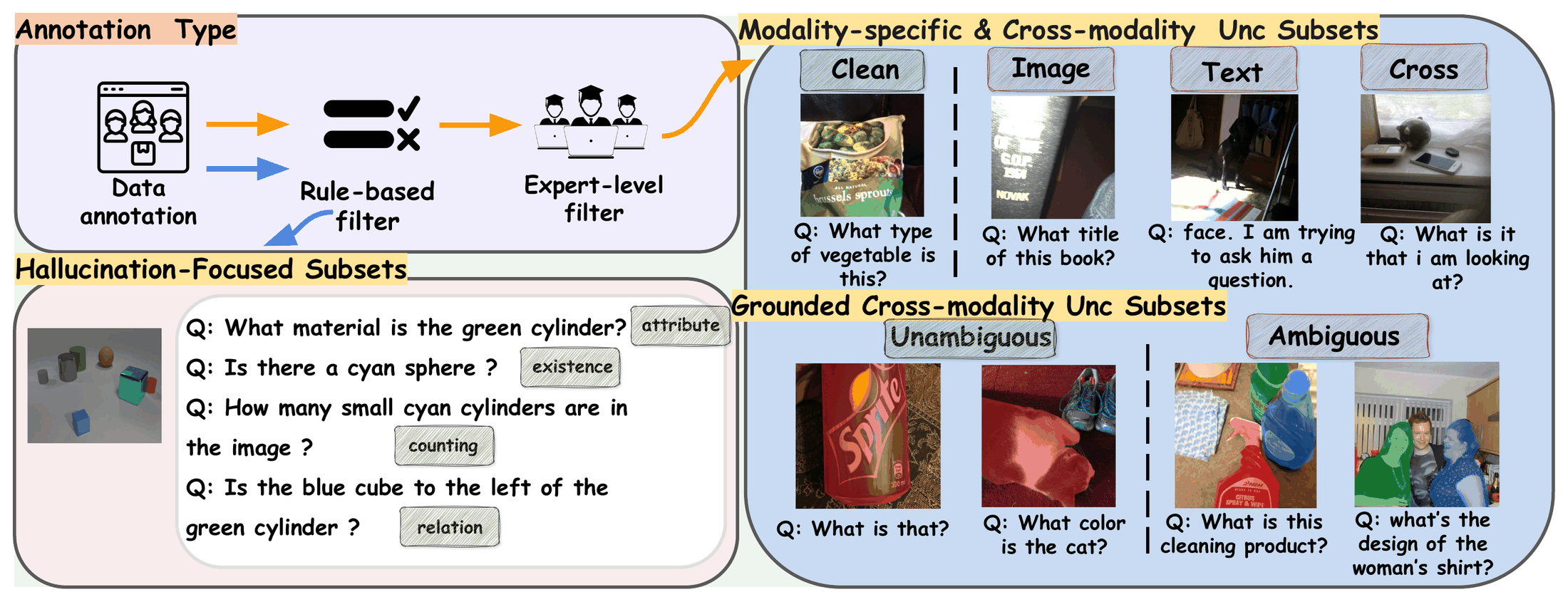
Visual uncertainty
Low-quality image artifacts such as blur, occlusion, or poor lighting.
“What title of this book?”
Next step: retake the image.
Vision-language models · Uncertainty quantification · Benchmark
CVPR 2026 TRUE-V Workshop
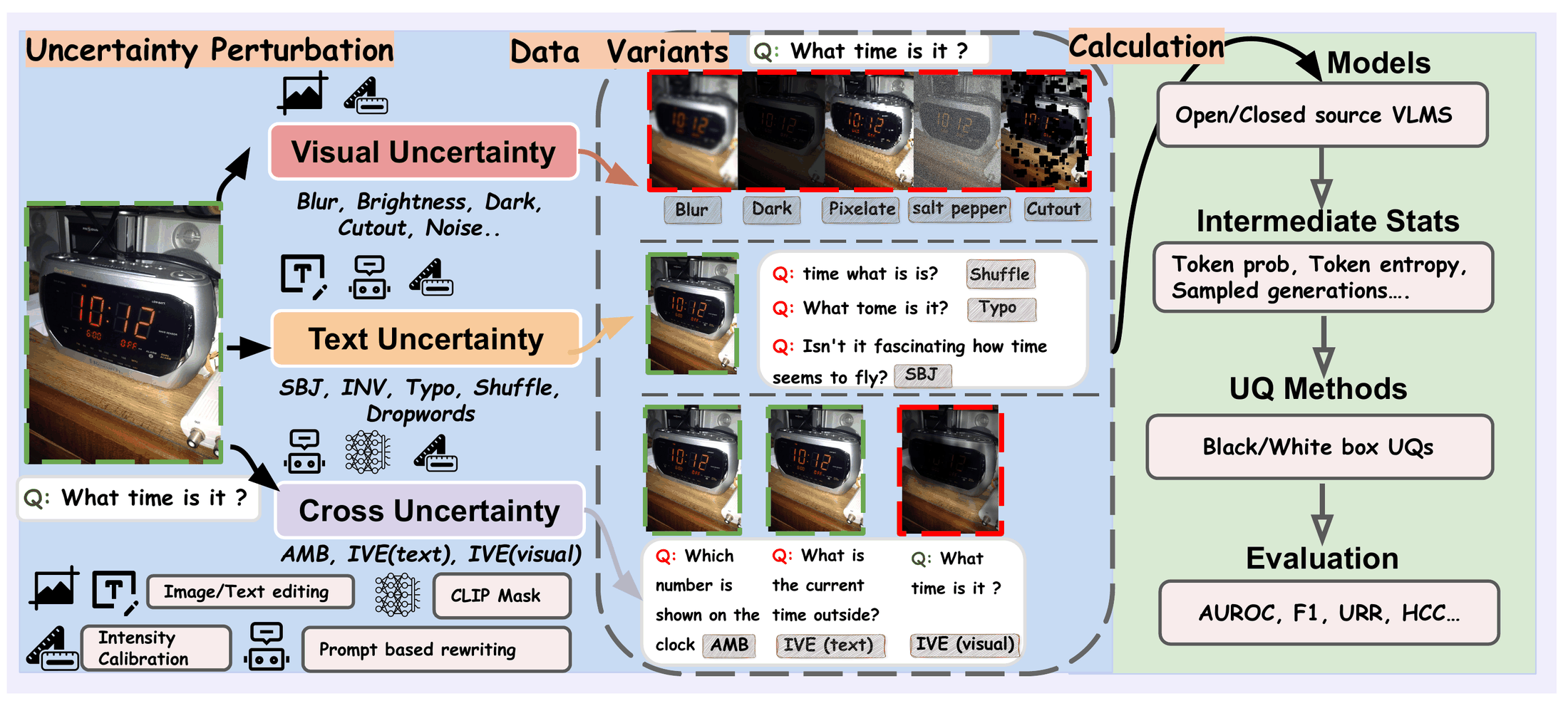
Uncertainty quantification (UQ) is vital for ensuring that vision-language models (VLMs) behave safely and reliably. A central challenge is to localize uncertainty to its source, determining whether it arises from the image, the text, or misalignment between the two. We introduce VLM-UQBench, a benchmark for modality-specific and cross-modal data uncertainty in VLMs. It consists of 600 real-world samples drawn from the VizWiz dataset, curated into clean, image-, text-, and cross-modal uncertainty subsets, and a scalable perturbation pipeline with 8 visual, 5 textual, and 3 cross-modal perturbations. We further propose two simple metrics that quantify the sensitivity of UQ scores to these perturbations and their correlation with hallucinations, and use them to evaluate a range of UQ methods across four VLMs and three datasets.
Empirically, we find that: (i) existing UQ methods exhibit strong modality-specific specialization and substantial dependence on the underlying VLM, (ii) modality-specific uncertainty frequently co-occurs with hallucinations while current UQ scores provide only weak and inconsistent risk signals, and (iii) although UQ methods can rival reasoning-based chain-of-thought baselines on overt, group-level ambiguity, they largely fail to detect the subtle, instance-level ambiguity introduced by our perturbation pipeline. These results highlight a significant gap between current UQ practices and the fine-grained, modality-aware uncertainty required for reliable VLM deployment.
Effective UQ must indicate both how uncertain the model is and where that uncertainty arises.
Low-quality image artifacts such as blur, occlusion, or poor lighting.
“What title of this book?”
Next step: retake the image.
Invalid or subjective questions that are vague or incoherent.
“face. I am trying to ask him a question.”
Next step: rephrase the question.
Ambiguous references or insufficient visual evidence given an otherwise clear question and image.
“What is it that i am looking at?”
Next step: defer.
VLM-UQBench combines four components into a unified benchmark for uncertainty in VLMs.
| Benchmark | Task / modality | Annotation type | Contrast granularity |
|---|---|---|---|
| AmbigQA | Open-domain QA | Ambiguity | Group |
| AbstentionBench | Open-domain QA | Abstention scenarios | Group |
| UNK-VQA | Open-ended VQA | Answerability | Group |
| VQ-FocusAmbiguity | Free-form VQA | Ambiguity (grounded) | Group |
| MM-UPD | Multiple-choice VQA | Unsolvability categories | Group |
| MuirBench | Multiple-choice VQA | Answerability | Sample |
| CertainlyUncertain | Free-form VQA | Aleatoric–epistemic uncertainty | Sample |
| VLM-UQBench (ours) | Free-form VQA | Modality-specific & cross-modality uncertainty | Sample |
AUROC and F1 assess how well each UQ method distinguishes uncertain samples from clean ones. Two new measures link UQ to modality-targeted perturbations and hallucination behavior.
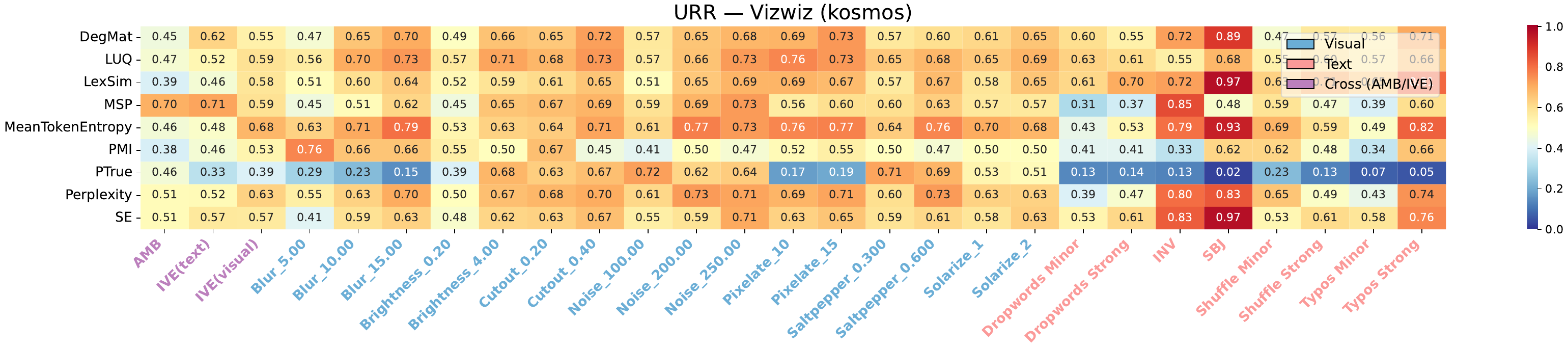
A higher URR indicates that method more consistently increases its uncertainty under perturbation .
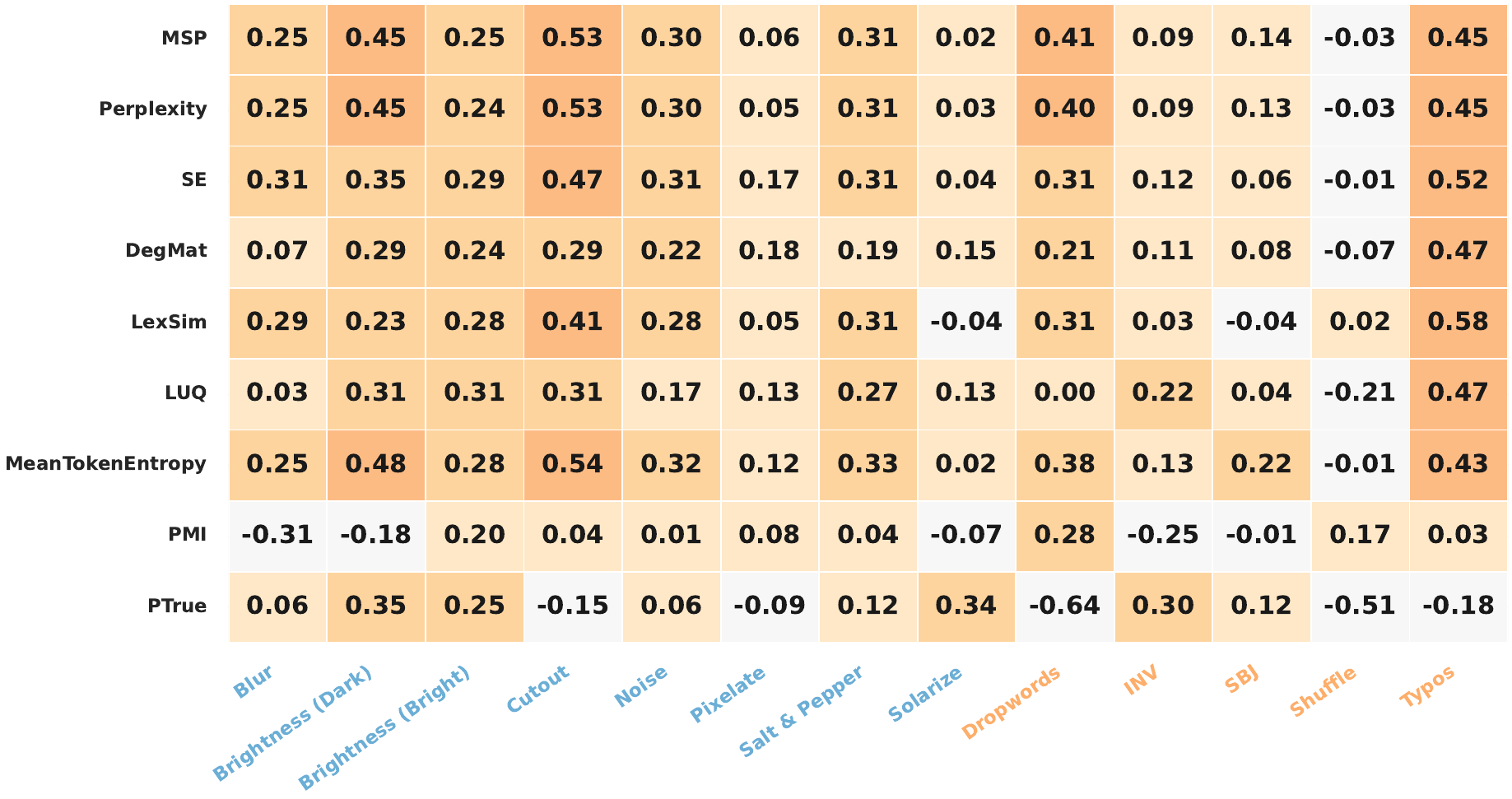
The point-biserial correlation between the uncertainty change and the hallucination label . A positive HCC indicates that hallucinated cases tend to exhibit larger uncertainty increases.
Models Kosmos-2, LLaVA, Qwen-VL, GPT-4o-mini · UQ methods 9 (6 white-box, 3 black-box) · Data VizWiz, VQ-FocusAmbiguity, VQAv2, CLEVR
UQ methods exhibit clear modality-specific specialization, and their performance is strongly model-dependent. On the curated VizWiz subsets, Semantic Entropy is particularly effective for textual uncertainty.
Swipe to see all four models.
AUROC for discriminating uncertain vs. clean samples. Outlined: best in the column. “–”: missing token-level statistics.
| Estimator | Kosmos-2 | LLaVA | Qwen-VL | GPT-4o-mini | ||||||||
|---|---|---|---|---|---|---|---|---|---|---|---|---|
| Image | Text | Cross | Image | Text | Cross | Image | Text | Cross | Image | Text | Cross | |
On grounded cross-modal ambiguity (VQ-FocusAmbiguity), the best UQ estimator matches or exceeds zero-shot, ZS-CoT, and ZS-ECoT prompting.
| Model | UQ-best | ZS | ZS-CoT | ZS-ECoT |
|---|---|---|---|---|
| Qwen-VL | 0.69 | 0.63 | 0.63 | 0.62 |
| GPT-4o-mini | 0.66 | 0.62 | 0.63 | 0.64 |
| Estimator | Kosmos-2 | LLaVA | Qwen-VL | GPT-4o-mini |
|---|
Bold: highest AUROC per model. “–”: no access to model-internal information.
On VizWiz and VQAv2, UQ sensitivity varies substantially across datasets, models, and perturbation types. UQ methods are overall most effective at detecting SBJ textual perturbations, and worse at capturing cross-modal perturbations injected with minimal semantic change.
Modality-specific uncertainty induces distinct hallucination types: visual blur alone causes a 64.7% hallucination rate on attribute tasks for Qwen-VL.
Hallucination rate (%): items correct on the clean sample that become incorrect on the perturbed counterpart.
| Perturbation | LLaVA | Qwen-VL | GPT-4o-mini | |||||||||
|---|---|---|---|---|---|---|---|---|---|---|---|---|
| Attr. | Count. | Rel. | Exist. | Attr. | Count. | Rel. | Exist. | Attr. | Count. | Rel. | Exist. | |
UQ methods fail to detect these perturbation-induced hallucinations: HCC(ΔU) is weak and model-dependent. HCC is low for visual blur across all models, despite it being a primary cause of hallucinations, and higher for low-impact perturbations such as typos.
@article{wang2026vlmuqbench,
  title   = {{VLM-UQBench}: A Benchmark for Modality-Specific and Cross-Modality
             Uncertainties in Vision Language Models},
  author  = {Wang, Chenyu and Chen, Tianle and Wu, Yuxin and He, Qijia and
             Chen, Mingyu and Ahmad, H. M. Sabbir and Batmanghelich, Kayhan and
             Li, Wenchao},
  journal = {arXiv preprint arXiv:2602.09214},
  year    = {2026}
}